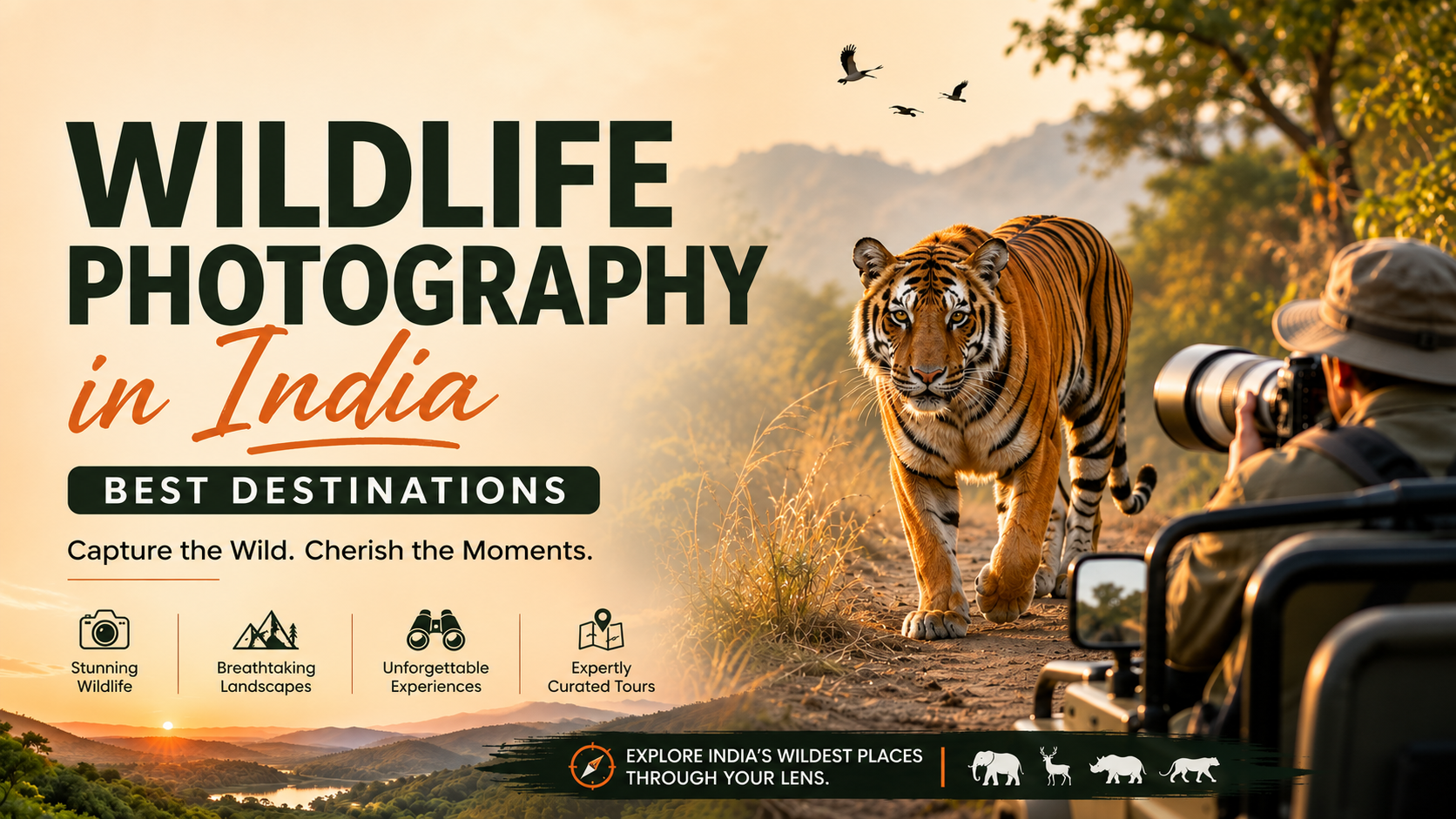
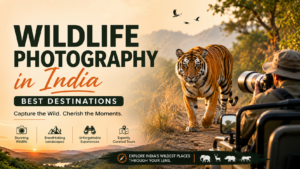
If you are searching for the ultimate places to photograph Indian wildlife and premier destinations for wildlife photography in India, India offers some of the most extraordinary natural ecosystems on earth. Containing over 70% of the global wild Bengal tiger population, the world’s last remaining wild Asiatic lions, the iconic Great Indian One-Horned Rhinoceros, and the legendary Black Panther of Kabini, India presents unmatched opportunities for photographers.
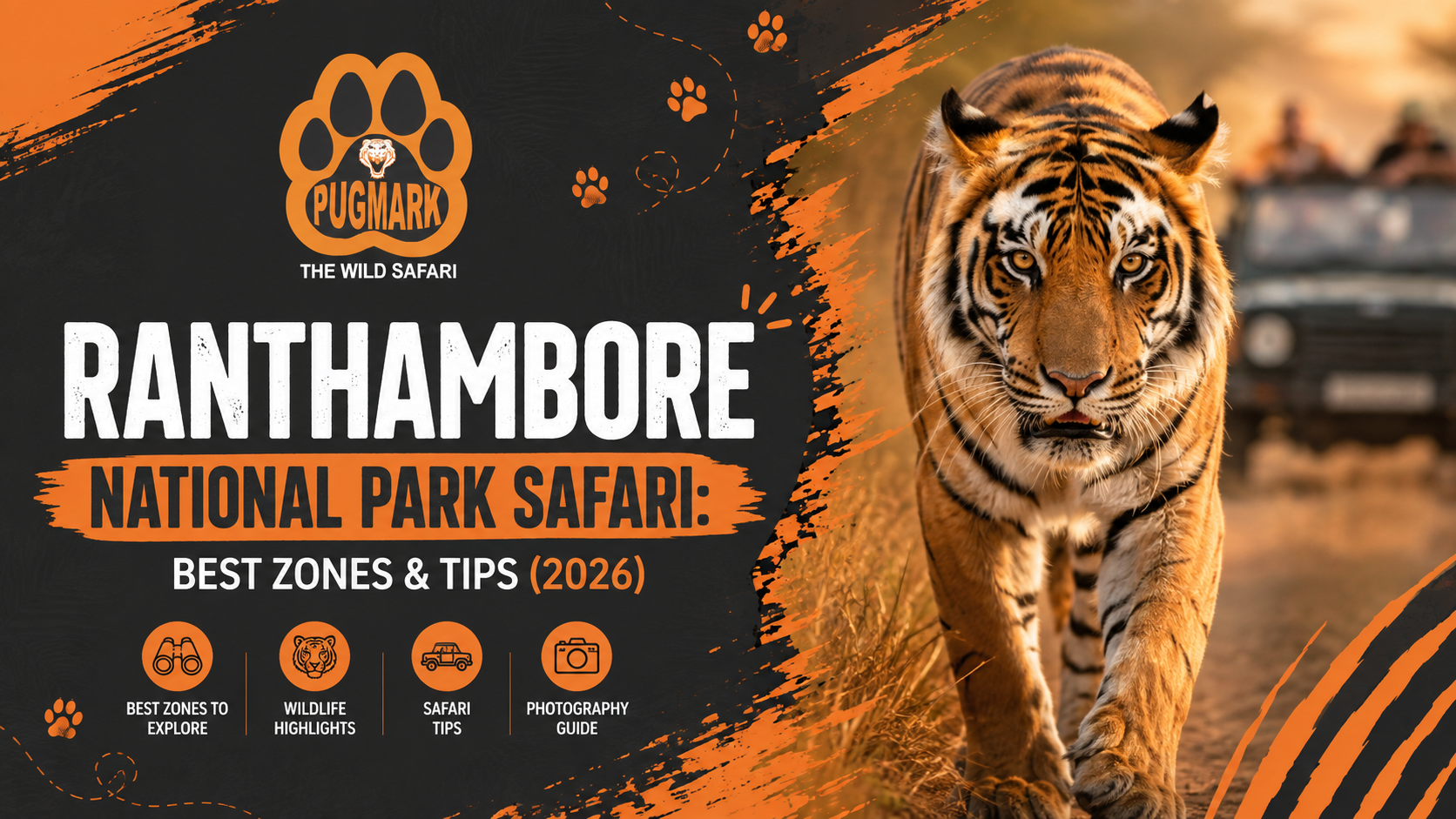
Key Takeaways: Places to Photograph Indian Wildlife
- Best Tiger Photography Parks: Tadoba-Andhari Tiger Reserve (Maharashtra) and Bandhavgarh National Park (Madhya Pradesh) rank as prime places to photograph Indian wildlife and master wildlife photography in India.
- Best Big Cat & Dark Forest Diversity: Kabini / Nagarhole (Karnataka) is world-famous for the rare Black Panther and rainforest photography.
- Best Megafauna & Birding: Kaziranga National Park (Assam) for Great Indian One-Horned Rhinos; Keoladeo National Park (Bharatpur) for migratory birds.
- Recommended Camera Gear: 100–400mm or 200–600mm telephoto zoom lenses paired with high-speed mirrorless bodies featuring Animal Eye-AF.
- Ideal Seasons: March to May for waterhole predator action; November to February for pleasant weather and golden light.
Table of Contents
- Introduction: Places to Photograph Indian Wildlife & Wildlife Photography in India
- Top Places to Photograph Indian Wildlife: Best Destinations for Wildlife Photography in India
- 1. Tadoba-Andhari Tiger Reserve – Places to Photograph Indian Wildlife
- 2. Bandhavgarh National Park – Places to Photograph Indian Wildlife
- 3. Kabini National Park – Places to Photograph Indian Wildlife
- 4. Kaziranga National Park – Places to Photograph Indian Wildlife
- 5. Ranthambore National Park – Places to Photograph Indian Wildlife
- 6. Jim Corbett National Park – Places to Photograph Indian Wildlife
- 7. Gir National Park – Places to Photograph Indian Wildlife
- 8. Keoladeo National Park – Places to Photograph Indian Wildlife
- Comparison of Places to Photograph Indian Wildlife
- Camera Gear for Places to Photograph Indian Wildlife
- Pro Tips for Places to Photograph Indian Wildlife
- Ethics in Places to Photograph Indian Wildlife
- How to Book Places to Photograph Indian Wildlife
- Frequently Asked Questions (FAQs)
Introduction: Places to Photograph Indian Wildlife & Wildlife Photography in India
When exploring the best places to photograph Indian wildlife and mastering wildlife photography in India, photographers are greeted by an astonishing variety of landscapes and species. Furthermore, within a single trip, a photographer can capture a Bengal tiger striding through 10th-century sandstone fort ruins in Ranthambore, wild Asian elephants traversing misty riverbeds in Jim Corbett, or a leopard perched high on a teakwood bough in the rainforest canopy of Kabini.
However, choosing among the top places to photograph Indian wildlife requires detailed understanding of seasonal light, animal movements, and local terrain. Consequently, in this guide, we break down the absolute premier national parks, gear recommendations, vehicle positioning tips, and optimal months for your safari.
Top Places to Photograph Indian Wildlife: Best Destinations for Wildlife Photography in India
1. Tadoba-Andhari Tiger Reserve – Places to Photograph Indian Wildlife
Located in Maharashtra, Tadoba-Andhari Tiger Reserve stands out among the top places to photograph Indian wildlife. Featuring dry deciduous teak forests, open bamboo thickets, and numerous perennial waterbodies, Tadoba provides clean backgrounds and extraordinary tiger sightings for wildlife photography in India.
Primary Photography Targets: Bengal Tigers (including famous bold mothers and cubs), Indian Leopards, Sloth Bears, Dholes (Indian Wild Dogs), and Gaur.
Lighting & Terrain Conditions: In addition, the dry terrain creates golden dust particles during morning safaris, making it one of the most rewarding places to photograph Indian wildlife with rim-lit backlight shots. In summer (March to May), tigers spend hours in waterholes, offering unobstructed viewlines.
- Best Safari Gates: Moharli, Kolara, and Navegaon in the Core zone; Devada, Adegaon, and Junona in the Buffer zones.
- Recommended Lenses: 100–400mm or 200–600mm telephoto zooms offer ideal flexibility.
- Optimal Months: March to May for waterhole action; November to February for crisp morning mist.
2. Bandhavgarh National Park – Places to Photograph Indian Wildlife
Tucked into the Vindhya hills of Madhya Pradesh, Bandhavgarh National Park is world-renowned among places to photograph Indian wildlife. Surrounded by steep sandstone cliffs and dominated by the ancient Bandhavgarh Fort, this reserve offers dramatic topography for big cat portraits in wildlife photography in India.
Primary Photography Targets: Bengal Tigers, Leopards, Sambar Deer, Barking Deer, Jackals, and raptors.
Lighting & Terrain Conditions: Bandhavgarh mixes open sal meadows (Taals) with rocky cliff faces. As a result, morning golden hour illuminating sandstone cliffs makes it one of the legendary places to photograph Indian wildlife.
- Best Safari Zones: Tala Zone (historic ruins), Magdhi Zone (high tiger density), and Khitauli Zone (open trails).
- Recommended Lenses: 70–200mm f/2.8 and 400mm / 600mm primes.
- Optimal Months: October to May.
3. Kabini National Park – Places to Photograph Indian Wildlife
Part of the Nilgiri Biosphere Reserve in Karnataka, Kabini ranks high among unique places to photograph Indian wildlife. It is world-famous for its evergreen atmosphere, giant teak trees, and the rare Black Panther.
Primary Photography Targets: Melanistic Leopard (Black Panther), Indian Leopards on trees, Bengal Tigers, Asian Elephants, and Malabar Pied Hornbills.
- Safari Advantage: Offers both Jeep safaris and boat safaris on the Kabini River.
- Recommended Lenses: Fast 400mm f/2.8 or 600mm f/4 primes under dark canopies.
- Optimal Months: October to May.
4. Kaziranga National Park – Places to Photograph Indian Wildlife
A UNESCO World Heritage site in Assam, Kaziranga National Park shelters over two-thirds of the world’s Great Indian One-Horned Rhinoceros population, placing it among the most essential places to photograph Indian wildlife and iconic spots for wildlife photography in India.
Primary Photography Targets: One-Horned Rhinoceros, Wild Water Buffalo, Swamp Deer, Asian Elephants, and migratory waterfowl.
- Best Safari Zones: Kohora (Central), Bagori (Western), and Agoratoli (Eastern).
- Recommended Lenses: 500mm or 600mm super-telephoto lenses.
- Optimal Months: November to April.
5. Ranthambore National Park – Places to Photograph Indian Wildlife
Situated in Rajasthan, Ranthambore National Park offers iconic heritage landscapes among places to photograph Indian wildlife. Here, tigers roam past ancient stepwells and stone arches under Ranthambore Fort.
- Best Safari Zones: Zones 1 to 5 for heritage core lakes; Zones 6 to 10 for rugged hills.
- Recommended Lenses: 100–400mm or 70–200mm zoom lenses.
- Optimal Months: October to June.
6. Jim Corbett National Park – Places to Photograph Indian Wildlife
Established in 1936, Jim Corbett National Park in Uttarakhand remains one of the most picturesque places to photograph Indian wildlife across mountain streams and Sal forests.
- Best Safari Zones: Dhikala Zone, Bijrani Zone, and Jhirna Zone.
- Recommended Lenses: 24–70mm for landscapes; 100–400mm for wildlife.
- Optimal Months: November 15 to June 15.
7. Gir National Park – Places to Photograph Indian Wildlife
Located in Gujarat, Gir National Park is the exclusive home of the Asiatic Lion, making it one of the rarest places to photograph Indian wildlife for enthusiasts of wildlife photography in India.
- Recommended Lenses: 100–400mm or 200–600mm zoom lenses.
- Optimal Months: December to March.
8. Keoladeo National Park – Places to Photograph Indian Wildlife
Keoladeo in Bharatpur is a premier bird sanctuary and one of the finest wetland places to photograph Indian wildlife on bicycle rickshaws.
- Recommended Lenses: 500mm or 600mm prime lenses with rickshaw mounts.
- Optimal Months: November to February.
Comparison of Places to Photograph Indian Wildlife & Wildlife Photography in India
Use this snapshot comparison table to evaluate the top places to photograph Indian wildlife based on target species, terrain, and recommended gear for wildlife photography in India:
| National Park | Primary Subject | Forest Type & Light | Recommended Lens Setup | Best Season |
|---|---|---|---|---|
| Tadoba | Bengal Tigers, Leopards, Bears | Dry teak, dust rim-light, waterholes | 100–400mm / 200–600mm | Mar – May & Nov – Feb |
| Bandhavgarh | High Tiger Density, Deer | Sal forest, sandstone fort cliffs | 70–200mm + 400mm / 600mm | Oct – May |
| Kabini | Black Panther, Leopards, Elephants | Dense evergreen canopy, river misty light | 400mm f/2.8 or 600mm f/4 Prime | Oct – May |
| Kaziranga | One-Horned Rhino, Wild Buffalo | Tall elephant grass, misty wetlands | 500mm / 600mm Super-telephoto | Nov – Apr |
| Ranthambore | Tigers at fort stepwells & lakes | Historic ruins, lakes, open scrub | 100–400mm or 70–200mm | Oct – Jun |
| Jim Corbett | Tigers on riverbeds, Elephants, Birds | Foothill rivers, Sal forest, grasslands | 24–70mm + 100–400mm | Nov 15 – Jun 15 |
| Gir | Asiatic Lions, Hyenas | Dry acacia scrub, open dirt tracks | 100–400mm / 200–600mm | Dec – Mar |
| Keoladeo | Sarus Cranes, Pelicans, Raptors | Wetlands, shallow marsh reflection | 500mm / 600mm + Rickshaw mount | Nov – Feb |
Camera Gear for Places to Photograph Indian Wildlife & Wildlife Photography in India
Photographing wildlife from an open 4×4 Maruti Gypsy jeep on bumpy forest tracks presents distinct technical challenges. Therefore, choosing the right camera setup is essential across all places to photograph Indian wildlife and for achieving top results in wildlife photography in India:
1. Camera Bodies: Speed & Autofocus
- Subject-Detection Animal Eye-AF: Modern mirrorless bodies (such as Sony A1 / A7 IV, Canon R5 / R6 II, Nikon Z8 / Z9) revolutionized experience across places to photograph Indian wildlife by locking focus on animal eyes.
- Burst Speed: Minimum 10 to 20 frames per second (fps).
- High ISO Cleanliness: Clean performance at ISO 3200 to 12800.
2. Telephoto Lenses
- Telephoto Zooms (100–400mm / 200–600mm / 150–600mm): The most versatile choice for Indian safaris.
- Super-Telephoto Primes (400mm f/2.8 or 600mm f/4): Maximum background blur (bokeh) in dark woods.
Pro Tips for Places to Photograph Indian Wildlife & Wildlife Photography in India
To maximize your image quality across top places to photograph Indian wildlife and excel in wildlife photography in India, apply these proven field strategies:
- Vehicle Alignment: Align the jeep parallel to the animal’s walking path for clean profiles.
- Shutter Speeds: 1/500s for resting animals; 1/2000s+ for active predators.
- Low-Angle Positioning: Crouch on the floorboard of your Gypsy to capture intimate eye-level angles.
Ethics in Places to Photograph Indian Wildlife
Ethical conduct is vital when visiting places to photograph Indian wildlife to keep habitats safe and sustainable:
- Maintain Silence: Keep voice levels low and use silent electronic shutters.
- No Luring: Never whistle or call out to animals.
- No Littering: Leave zero trace inside national park boundaries.
How to Book Places to Photograph Indian Wildlife
Executing a trip to the finest places to photograph Indian wildlife requires expert local logistics. At Pugmark – The Wild Safari, we specialize in tailor-made photography safaris with private 4×4 vehicles, photography-trained drivers, and strategic core zone reservations.
Frequently Asked Questions (FAQs)
What are the top places to photograph Indian wildlife?
Tadoba-Andhari Tiger Reserve, Bandhavgarh National Park, and Kabini are widely regarded as the single best places to photograph Indian wildlife due to high predator sighting consistency.
What camera lens is best for places to photograph Indian wildlife?
A 100–400mm or 200–600mm telephoto zoom lens is the best choice across all places to photograph Indian wildlife due to versatile framing.
Is a private safari jeep necessary when visiting places to photograph Indian wildlife?
Yes. Booking a private 4×4 Gypsy jeep allows full freedom for heavy camera gear and low-angle shooting.
What is the best month to visit places to photograph Indian wildlife?
For maximum waterhole predator sightings, March to May is ideal. For pleasant light and misty landscapes, November to February is best.