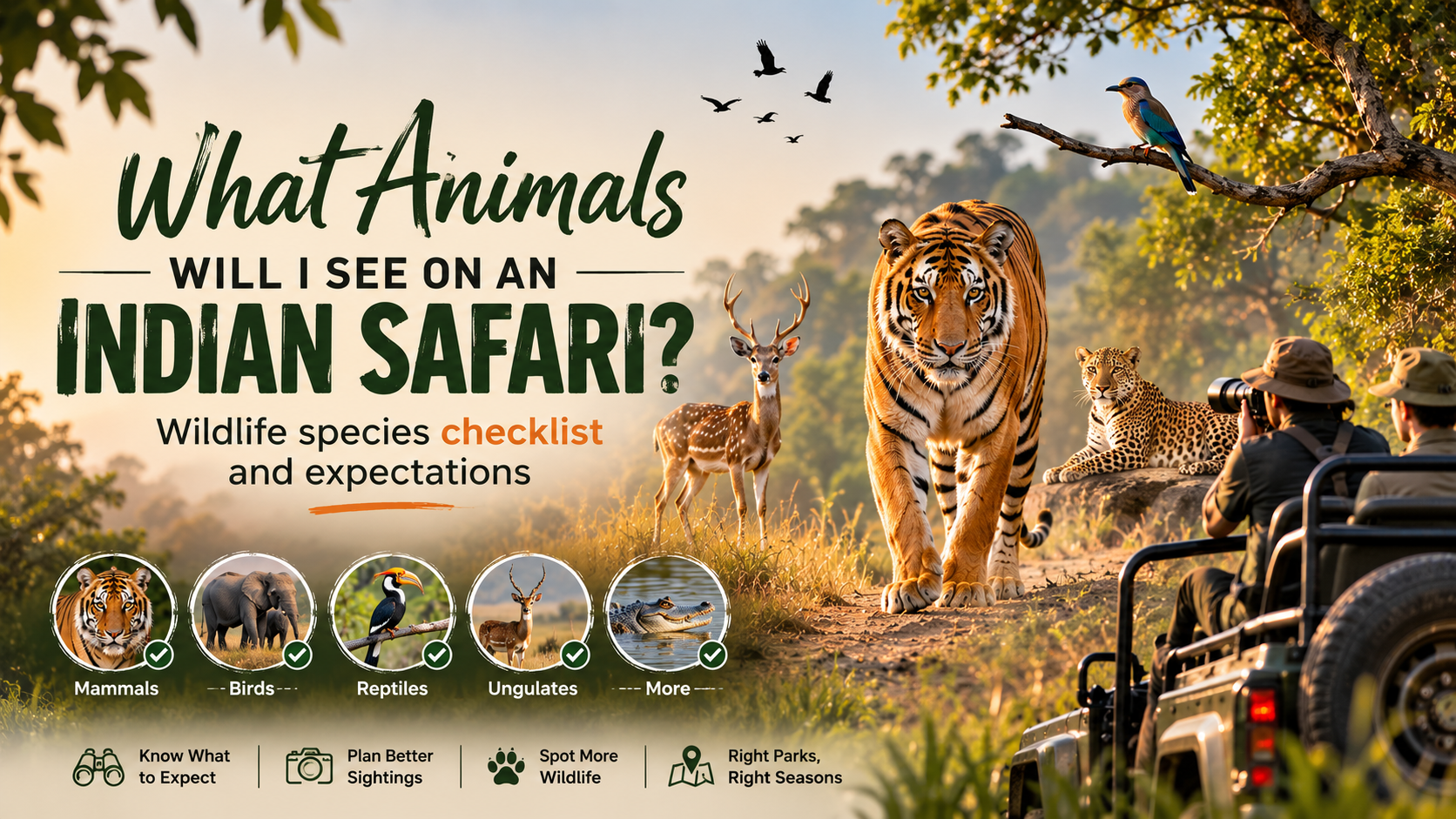
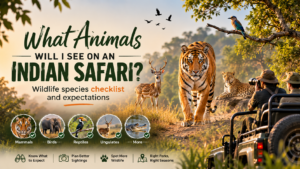
If you are asking what animals will I see on an Indian safari, India offers one of the most thrilling wildlife experiences on the planet. Containing over 70% of the world’s wild Bengal tigers, the last wild Asiatic lions, the iconic Great Indian One-Horned Rhinoceros, wild Asian Elephants, and the rare Black Panther, an Indian wildlife safari delivers an unforgettable encounter with nature.
Key Takeaways: What Animals Will You See on an Indian Safari?
- The Big Five of India: Royal Bengal Tiger, Indian Leopard, Asian Elephant, Great Indian One-Horned Rhinoceros, and Asiatic Lion.
- Predators & Scavengers: Sloth Bears, Dholes (Indian Wild Dogs), Striped Hyenas, Golden Jackals, and Jungle Cats.
- Herbivores & Ungulates: Gaur (Indian Bison), Sambar Deer, Chital (Spotted Deer), Barasingha (Swamp Deer), Nilgai (Blue Bull), Blackbuck, and Chinkara.
- Primates & Reptiles: Hanuman Langurs, Rhesus Macaques, Marsh Crocodiles (Muggers), Gharials, and Monitor Lizards.
- Avian Species: Great Indian Hornbills, Crested Serpent Eagles, Peafowl, Kingfishers, and migratory waterfowl.
Table of Contents
- Introduction & Indian Safari Expectations
- The Big Five: What Animals Will I See on an Indian Safari?
- Other Carnivores & Scavengers Checklist
- Herbivores, Deer & Antelopes Checklist
- Primates, Reptiles & Birdlife Checklist
- Wildlife Species Checklist by National Park (Comparison Table)
- Factors Influencing What Animals You Will See
- How to Book Your Safari with Pugmark Safari
- Frequently Asked Questions (FAQs)
Introduction & Indian Safari Expectations
Planning your first trip to India’s national parks often raises the big question: what animals will I see on an Indian safari? Unlike African open savannahs, Indian safaris take place in dense Sal forests, dry teak woodlands, bamboo thickets, riverine floodplains, and rocky ravines. Consequently, wildlife encounters in India are intimate, tracking-based, and filled with suspense.
Furthermore, understanding species distribution across different parks helps set realistic expectations. For example, while you will see Asian elephants in Jim Corbett or Kabini, you will find One-Horned Rhinoceroses exclusively in Assam’s Kaziranga, and Asiatic Lions only in Gujarat’s Gir forest.
In this comprehensive checklist, we break down every major mammal, predator, herbivore, and bird species you can expect when asking what animals will I see on an Indian safari.
The Big Five: What Animals Will I See on an Indian Safari?
1. Royal Bengal Tiger (Panthera tigris tigris)
The undisputed king of the Indian jungle. The Bengal tiger is the primary reason millions of travelers ask what animals will I see on an Indian safari. Adult male tigers can weigh up to 260 kg (570 lbs), while females average around 140–160 kg.
- Where to See Them: Tadoba-Andhari Tiger Reserve, Bandhavgarh, Ranthambore, Kanha, Pench, and Jim Corbett.
- Sighting Expectation: High in Tadoba and Bandhavgarh during summer months (March–May) near water bodies.
2. Indian Leopard & Black Panther (Panthera pardus fusca)
Stealthy, agile, and master climbers. Leopards thrive across Indian forests, often lounging on tree branches to avoid tigers. In Kabini (Nagarhole), you may even encounter the legendary melanistic Black Panther (“Saya”).
- Where to See Them: Kabini (Karnataka), Jawai (Rajasthan – famous for granite hill leopards), Jhalana (Jaipur), Tadoba, and Bandhavgarh.
- Sighting Expectation: Moderate to high in dedicated leopard reserves like Jawai and Kabini.
3. Asian Elephant (Elephas maximus)
Reverently called the “Gentle Giant of the Jungle,” Asian elephants roam in close-knit matriarchal herds. Males feature impressive tusks (“Tuskers”).
- Where to See Them: Jim Corbett National Park (Dhikala riverbed), Kabini/Nagarhole, Kaziranga, and Periyar.
- Sighting Expectation: Very high in Corbett and Kabini backwaters.
4. Great Indian One-Horned Rhinoceros (Rhinoceros unicornis)
Featuring armor-like skin folds and a single thick horn, this prehistoric-looking herbivore weighs up to 2,200 kg.
- Where to See Them: Kaziranga National Park (Assam), Manas, and Pobitora Wildlife Sanctuary.
- Sighting Expectation: Near 100% guarantee during safaris in Kaziranga.
5. Asiatic Lion (Panthera leo persica)
Slightly smaller than African lions with darker manes and a distinctive longitudinal fold of skin along their belly. Gir is their sole surviving wild habitat on earth.
- Where to See Them: Gir National Park & Sanctuary (Gujarat).
- Sighting Expectation: High during morning jeep drives on open dirt tracks.
Other Carnivores & Scavengers Checklist
Beyond the big five, when asking what animals will I see on an Indian safari, you will encounter an impressive roster of secondary predators:
- Sloth Bear (Melursus ursinus): Shaggy black bears with white chest patches. Famous for digging termite mounds. Best seen in Tadoba, Satpura, and Daroji.
- Dhole / Indian Wild Dog (Cuon alpinus): Ferocious pack hunters with reddish coats and bushy black tails. Known for coordinated hunts in Pench, Kanha, and Kabini.
- Striped Hyena (Hyaena hyaena): Nocturnal scavengers seen in dry scrub forests like Velavadar, Ranthambore, and Gir.
- Golden Jackal (Canis aureus): Common scavengers seen trotting across meadows in almost all national parks.
- Jungle Cat & Fishing Cat: Elusive small felids spotted during late afternoon or night buffer drives.
Herbivores, Deer & Antelopes Checklist
Prey species form the backbone of the jungle ecosystem. Consequently, these are the most frequent answers when travelers inquire what animals will I see on an Indian safari:
- Gaur / Indian Bison (Bos gaurus): The largest wild bovine in the world, weighing up to 1,500 kg with white “stockings” on their legs. Seen in Tadoba, Kanha, and Kabini.
- Sambar Deer (Rusa unicolor): Large dark brown deer with impressive antlers; tiger’s favorite prey.
- Chital / Spotted Deer (Axis axis): Beautiful white-spotted deer seen in large herds across all Indian parks.
- Barasingha / Swamp Deer (Rucervus duvaucelii): Known for their 12-tined antlers. Saved from extinction in Kanha (Hard-ground Barasingha) and abundant in Kaziranga.
- Nilgai / Blue Bull (Boselaphus tragocamelus): Asia’s largest antelope, endemic to Indian open plains.
- Blackbuck (Antilope cervicapra): Spiral-horned antelopes famous for high leaps. Best seen in Velavadar (Gujarat).
- Chinkara / Indian Gazelle: Delicate desert gazelle seen in Ranthambore and Thar Desert.
Primates, Reptiles & Birdlife Checklist
- Hanuman Langurs & Rhesus Macaques: Langurs sit high in trees and give sharp “alarm calls” when a tiger or leopard is nearby—acting as the jungle’s natural radar system.
- Marsh Crocodile (Mugger) & Gharial: Mugger crocodiles bask on riverbanks in Ranthambore and Tadoba; fish-eating Gharials inhabit Corbett’s Ramganga River.
- Birdlife Highlights: Over 1,300 bird species call India home. You will see Indian Peafowl, Great Indian Hornbills, Crested Serpent Eagles, Changeable Hawk-Eagles, Pied Kingfishers, and Storks.
Wildlife Species Checklist by National Park
Use this master checklist to match your dream wildlife species with the right destination when asking what animals will I see on an Indian safari:
| National Park | Primary Animals You Will See | Tiger Sighting Odds | Best Safari Season |
|---|---|---|---|
| Tadoba | Bengal Tigers, Leopards, Sloth Bears, Gaur, Dholes | Very High (85–95%) | Mar – May & Nov – Feb |
| Bandhavgarh | Bengal Tigers, Leopards, Sambar, Barking Deer | Very High (80–90%) | Oct – May |
| Kabini | Black Panther, Leopards, Asian Elephants, Tigers, Gaur | Moderate to High (60–75%) | Oct – May |
| Kaziranga | One-Horned Rhinos, Wild Buffalo, Swamp Deer, Elephants | Moderate (40–50%) | Nov – Apr |
| Ranthambore | Bengal Tigers, Leopards, Crocodiles, Chinkara | High (70–85%) | Oct – Jun |
| Jim Corbett | Asian Elephants, Bengal Tigers, Gharials, 600+ Birds | Moderate (50–65%) | Nov 15 – Jun 15 |
| Gir | Asiatic Lions, Leopards, Hyenas, Chousingha | N/A (Lion Odds: 85–95%) | Dec – Mar |
Factors Influencing What Animals You Will See
To maximize your wildlife sightings on an Indian safari, keep these crucial field factors in mind:
- Season & Temperature: Summer months (March to May) dry out water holes, forcing animals to congregate around water bodies. Winter months (November to February) feature dense foliage but pleasant weather.
- Number of Safaris: Taking 4 to 6 safaris significantly increases your chances of spotting elusive big cats compared to a single drive.
- Guide & Driver Skill: Expert naturalists who listen for monkey alarm calls and pugmarks drastically improve sighting success.
How to Book Your Safari with Pugmark Safari
Planning an authentic safari to see India’s extraordinary wildlife requires expert logistics. At Pugmark – The Wild Safari, we specialize in tailor-made wildlife itineraries with private 4×4 Gypsy vehicles, top-tier naturalists, and advance core zone bookings.
Frequently Asked Questions (FAQs)
What animals will I see on an Indian safari for the first time?
On a standard Indian safari, you will almost certainly see Chital (Spotted Deer), Sambar Deer, Hanuman Langurs, Peacock, Wild Boar, and various raptors. Depending on the park and number of safaris, you have a high probability of seeing Bengal Tigers, Asian Elephants, or Leopards.
Are tiger sightings guaranteed on an Indian safari?
No wildlife sighting in a wild national park is 100% guaranteed. However, booking 4 to 6 safaris in high-density parks like Tadoba or Bandhavgarh during dry months yields an 85–95% sighting success rate.
Can I see lions and tigers on the same Indian safari?
No. Asiatic Lions live exclusively in Gir National Park (Gujarat), where wild tigers do not exist. Bengal Tigers live in reserves across Central, North, and South India. A multi-destination wildlife tour is needed to see both.
Is an Indian safari safe for families and children?
Yes. Indian safaris are conducted from sturdy, open-top 4×4 Maruti Gypsy vehicles accompanied by certified government forest guides and experienced drivers who adhere to strict park safety rules.